Traditional search isn’t disappearing. But it’s changing fast, and pretending otherwise is how brands get caught flat-footed.
Here’s the shift, in two simple columns.
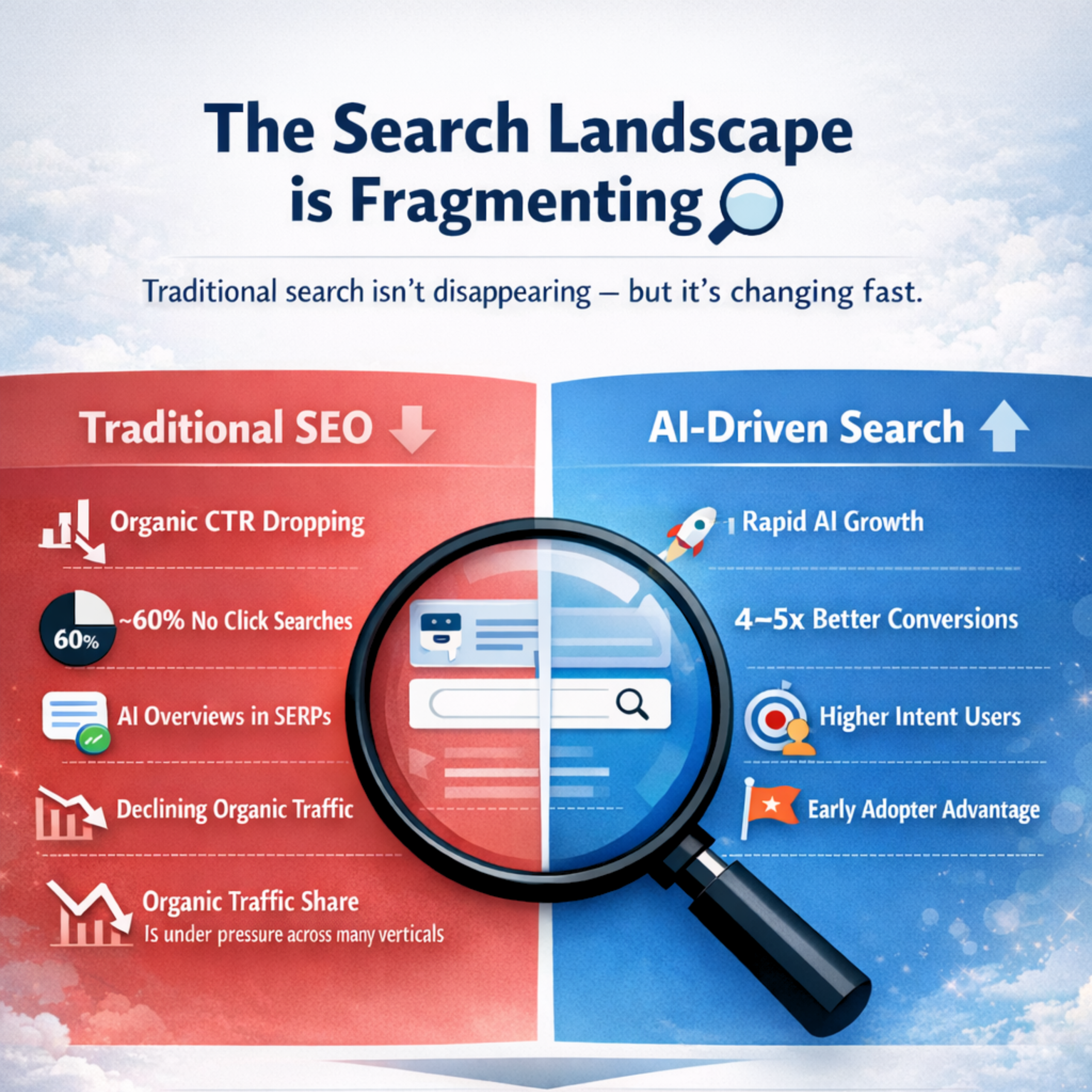
What’s happening to classic SEO
Organic click-through rates are quickly declining as the search results page gets more crowded, and AI Overviews increasingly satisfy the user’s intent right there on the page. The headline number: roughly 60% of Google searches now end without any click at all, and that climbs dramatically, into the 80-90% range, on queries where an AI Overview or AI Mode answer appears. Zero-click isn’t in any way new (featured snippets and knowledge panels started this years ago, along with waves of panic), but the AI layer has poured fuel on it. The result is real pressure on organic traffic share across a lot of verticals.
What’s emerging alongside it
The other column (the blue one, it’s on the right) is where it gets interesting. AI-driven search usage is growing at a rate that makes normal marketing growth look flat, AI referral traffic has grown several hundred percent year over year, with some datasets showing individual platforms up four-figure percentages.
And here’s the part that matters most: the traffic that does come through AI converts better. Across the major studies, AI-referred visitors convert at somewhere between roughly 2x and 4x the rate of traditional organic (Similarweb put it at 11.4% vs 5.3% in e-commerce; Semrush at ~4.4x across industries), with some sources reporting far higher lifts on signups. Fewer clicks, but higher intent and deeper engagement, because the AI has effectively pre-qualified the user before they ever arrive.
The honest caveat (that only makes the case stronger)
Two things worth saying plainly, because most hot takes skip them. First, AI referrals are still a small slice of total traffic today, under 1% for most sites. Second, it’s under-measured: a lot of AI-sourced visits show up as “direct” traffic because the referrer data isn’t passed, so many brands are getting AI value they’re not even attributing correctly.
Neither of those undercuts the trend. They sharpen it. A small, fast-growing, high-converting, under-measured channel is the exact profile of an early-mover advantage, the brands that adapt now compound a lead while everyone else waits for it to show up cleanly in a dashboard that isn’t built to see it yet.
The strategy: optimize for both
This isn’t SEO or AI search. It’s both.
Keep doing the traditional SEO work, it still drives the majority of discoverable traffic, and, notably, the pages AI engines cite most are overwhelmingly the ones that already rank well. Then optimize for AI-driven discovery on top of it (call it GEO, AEO, AIO, whatever the industry settles on). Because visibility is no longer just about rankings. It’s about being referenced, summarized, and trusted across every search surface, the traditional ten blue links, the AI Overview, the chatbot answer, the assistant recommendation.
Same fundamentals, more surfaces. The brands that treat it as one connected discovery system instead of a turf war between “SEO” and “AI” are the ones who’ll own the next few years of it. If anyone ever serves you the option to optimize just for one – ignore that option ASAP. Cover all bases, even partial coverage is better than ignoring what could eventually become the cornerstone of your traffic, discovery or the new trend of how the internet operates for a hot minute.
(And if you run apps: this exact shift is already reshaping ASO, since the app stores are going the same AI-answer direction. That’s a whole strategy conversation on its own. Feel free to contanct and discuss)